Cisco Downloading Xmldefault Cnf Xml
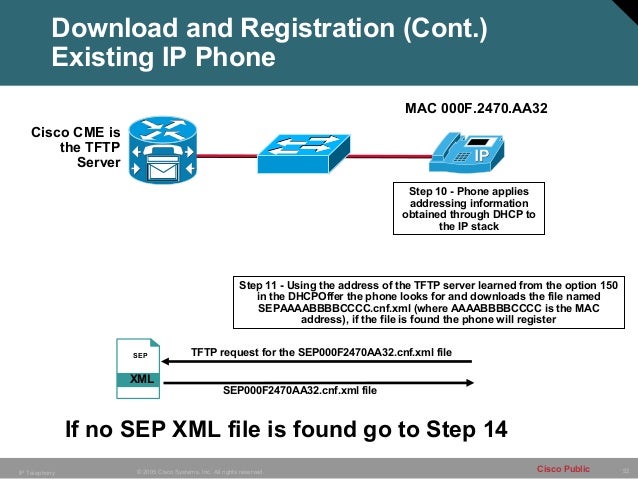
Cisco Downloading Xmldefault Cnf Xml. This document provides the procedure for how to upgrade Cisco IP phone firmware with Cisco CallManager Express. Troubleshooting Phone Registration in Cisco Unified CMETable Of Contents. Troubleshooting IP Phone Registration in Cisco Unified CMEContents. All IP phones in a Cisco. Did anyone successfully registered Cisco CP-8851 phone with Asterisk based SIP system? Can you share a sample. Once you have files in place you will need to modify XMLDefault.cnf.xml and make sure your firmware filename is correctly entered there. Also, you will need to rename SEP.
After a Cisco CallManager upgrade, some IP phones do not download the new IP phone load from TFTP and do not register with the Cisco CallManager. This document discusses and provides a resolution for this issue. Cisco recommends that you have knowledge of these topics:. Cisco CallManager Administration. The information in this document is based on these software and hardware versions:. Cisco CallManager 3.x and later. Cisco 7900 IP phones The information in this document was created from the devices in a specific lab environment.
All of the devices used in this document started with a cleared (default) configuration. If your network is live, make sure that you understand the potential impact of any command. Refer to for more information on document conventions. After a Cisco CallManager upgrade, some of the IP phones do not boot up completely.
They are stuck in various states of the boot process that include 'Configuring CM List' and 'Upgrading Software'. The IP phones also do not register with the Cisco CallManager and display the.cnf.xml files cannot be located error message.
Complete these steps to resolve this problem:. Open the Cisco CallManager Administration page. Select Service Service Parameters. Select the CallManager server and choose Cisco Tftp for the service.
Click Advanced. Set these parameters under Clusterwide Parameters (parameters that apply to all servers):.
Cisco Xml Api
Set the value for Build CNF Files. to Build All. Note: When you set the Build CNF Files service parameter to Build All, the TFTP server builds both.cnf.xml and.cnf format configuration files for all devices. When you set this service parameter to Build None, the TFTP server builds only.cnf.xml files for all devices. When this parameter is set to Build Selective, which is the default value, the TFTP server builds.cnf.xml files for all devices.
It also builds.cnf files only for a select list of devices that do not support.cnf.xml. Set the Enable Caching of Constant and Bin Files at Startup parameter to False. Set the Enable Caching of Configuration Files parameter to False. Note: By default, Enable Caching of Configuration Files is set to True. When this parameter is set to True, all the CNF and XML files are built and kept only in memory. When this parameter is set to False, TFTP writes all the CNF and XML files to the disk under the TFTP path C: Program Files Cisco TFTPPath.
It can take a long time to write these files to the disk if a large number of devices exist in the network. Therefore, set the Enable Caching of Configuration Files parameter to False to reduce the performance of the TFTP server. Restart the Cisco TFTP service. Complete these steps:. Select Application Cisco CallManager Serviceability Tools Control Center. Click on the Cisco CallManager server, choose Cisco TFTP and click Restart.
Note: You are now able to see the configuration files for the devices in C: Program Files Cisco TFTPPath. Restart the affected Cisco IP phones. Set the values of the Enable Caching of Constant and Bin Files at Startup parameter and the Enable Caching of Configuration Files parameter back to True. Note: There are several problems that can cause a Cisco IP phone not to register. Refer to for more information on those problems.
2000 2427 2428 CPSIP060111A SIP41.9-2-3S SIP41.8-5-2S SIP41.8-5-2S SIP41.8-5-2S SIP70.8-4-2S SIP70.8-4-2S SCCP70.8-3-1S cmterm7985.4-1-4-0.