Postman And Phillips Serial Position Effect Diagram
A and S proposed a model in which verbal rehearsal was used to learn the associates. The effect of rehearsal was to transfer info about that item into LTM. The extent of learning depended on how. Words at the beginning and end were easier to recall than words in the middle. Serial position effect. Postman and phillips. Postman And Phillips Serial Position Effect Graph. 5/20/2017 0 Comments The opposite of a liquid market is called a. People often remember well the information at the beginning and the end rather than in the middle, which is referred to as the 'serial position effect' (Day, 2006; Postman & Phillips, 1965). Instead of changing the presentation order, emphasizing important information can be another way to improve accessibility.
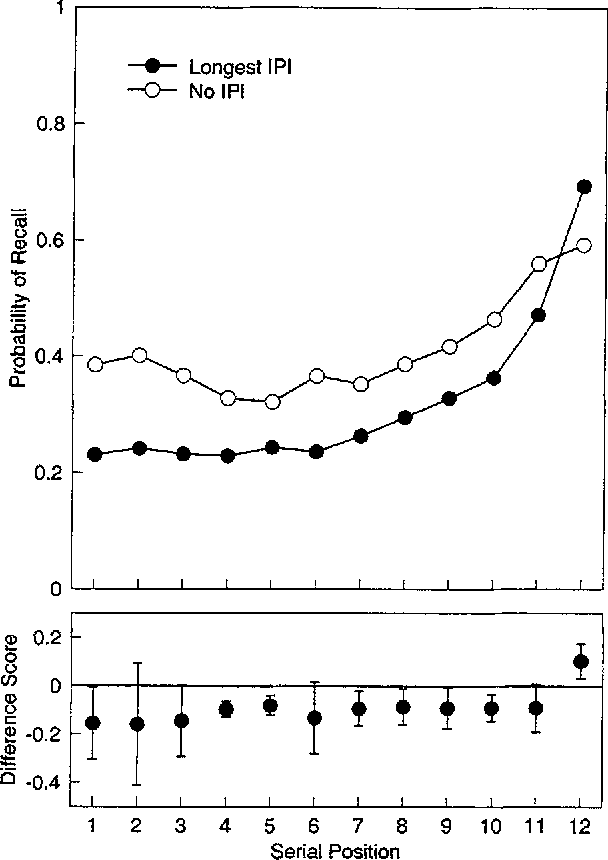
Abstract In-immediate free recall, words recalled successively tend to come from nearby serial positions. Kahana (1996) documented this effect and showed that this tendency, which the authors refer to as the lag recency effect, is well described by a variant of the search of associative memory (SAM) model (J. Raaijmakers & R. Shiffrin, 1980, 1981).
In 2 experiments, participants performed immediate, delayed, and continuous distractor free recall under conditions designed to minimize rehearsal. The lag recency effect, previously observed in immediate free recall, was also observed in delayed and continuous distractor free recall. Although two-store memory models, such as SAM, readily account for the end-of-list recency effect in immediate free recall, and its attenuation in delayed free recall, these models fail to account for the long-term recency effect. By means of analytic simulations, the authors show that both the end of list recency effect and the lag recency effect, across all distractor conditions, can be explained by a single-store model in which context, retrieved with each recalled item, serves as a cue for subsequent recalls. The recency effect refers to the decline in memory performance with the passage of time or the presence of interfering events.
Although recency effects in recognition memory are long lived and resistant to interference (e.g., Strong, 1912), recency effects in free and probed recall are short lived and are extremely vulnerable to interference (e.g., Postman & Phillips, 1965). In this article we analyze the recency effect in free recall, focusing on the details of retrieval under various distractor conditions. Nokia pc suite 4 81 download music. In free recall, the recency effect is almost completely eliminated by 15 s of a distractor task (Glanzer & Cunitz, 1966; Postman & Phillips, 1965). The special status of the recency effect in free recall is highlighted by findings that numerous experimental manipulations and participant variables have different effects on recency and prerecency items. For example, list length (Murdock, 1962), interitem similarity.
Chapter 2 Short-Term Memory Short-Term Memory and Working Memory What is the Difference? Short-Term Memory (STM): A store containing small amounts of information over brief intervals, tested either immediately or after a short delay. STM is part of Working Memory (WM) Often tested by digit span (Jacobs, 1887) Working Memory (WM): A system for the temporary storage and manipulation of information to allow for reasoning, learning, and comprehension. All theories of WM assume that complex reasoning & learning tasks require a mental workspace to hold and manipulate information Often tested by working memory span, a more complex task.
Recency Effect

Digit Span Test your digit span Read each sequence as if it were a telephone number, then close your eyes and try to repeat it back. Start with the four digit numbers, and continue until you fail on both sequences at a given length. Your span is one digit less than this.
Memory Span Capacity Digit span is limited to about six to seven digits for most people Some recall as few as four or as many as ten plus Though classically tested with digits, other stimuli (e.g. Letters or words) can be used to assess memory span changing the difficulty of the task. Memory span depends on two abilities: Remembering what the items are – this is trivial (easy) for familiar English digits but would be harder for Finnish. Remembering the order of the items. How is Order Remembered? Chaining Item #1 Item #2 Item #3 Item #4 Item #5 Item #6 Chaining: One possible method of remembering the order of the items in which each item is linked to the next in the series. Chaining predicts that if the chain is broken, no further items can be recalled.
Richard C Atkinson
In reality, despite an increase of errors after one mistake, forgetting a link is not as catastrophic as chaining predicts. Which sequence is easier to repeat back? CTAIILTCSFRO FRACTOLISTIC Both chains have the same letters in them but one is harder than the other. This string of letters can be broken into syllables which are remembered in “chunks” Memory Span Chunking RATSHOELET RAT SHOE LET Memory Span Chunking George Miller suggested that memory span is limited to a certain number of chunks Chunking - Grouping a series of random items into a smaller number of meaningful segments to enhance recall, often related to language patterns. Chunking can also be based on the prosody (rhythm) of the presentation list, like the alphabet.
Random digits are best chunked into groups of about three items, like telephone numbers xxx-xxxx or social security numbers xxx-xx-xxxx. Memory Span Errors Short-term memory for consonants appears to rely partially on an acoustic code, even when the letters are presented visually (Conrad, 1964) As the acoustic (sound-based) information rapidly fades, errors reveal how the items are processed. Items become confused when they include consonants with a similar sound (e.g. P vs V), instead of those with a similar visual form (P vs R). Memory is better for lists of consonants with dissimilar sounds – so CVDPGT vs KRXLYF is easier than PTCVBT. Interference versus Trace Decay Study: XRQ Count Backwards by 3 from: 49 Recall: Distractor Task In a Peterson task, a distractor task is introduced following a study item, impairing memory for the original study item.
This happens even when the distractor task is unrelated to the study list (e.g. Involves numbers not letters) – unlike interference in LTM. Similar Results for Trigrams and Word Triplets. The Petersons concluded that short-term memory traces decay as a function of time (simple trace decay) not because of interference from the distractor task (involving numbers). Interference Builds Up Over Trials Study: CAT Count Backwards by 3 from: 49 Recall: Trial #1 Study: DOG Count Backwards by 3 from: 26 Recall: The idea of trace decay does not explain observed changes in forgetting over multiple trials: Forgetting is nonexistent on early trials but builds up over several trials using similar items. This suggests the effect is caused by interference from previous trials, because of the similarity to the later ones Trial #2 From Loess (1968).
Serial Position Effect Psychology
Copyright © Elsevier. Reproduced with permission. Testing the Interference Theory Supporting the interference perspective, recall declines with increasing numbers of trials involving items from the same category, such as “kinds of pets” but rebounds when the category changes to “names of colors.” 4 categories = items drawn from 4 kinds of items presented in random order Same category = a series of items all from the same category Category Shifts The spikes show release from interference whenever the category changes. From Loess (1968). Copyright © Elsevier.
Reproduced with permission. From Postman and Phillips (1965).